The Supporter’s Shop is Now Open!
The Supporter’s Shop is officially open! See what’s available, why we built it, and how your support can help shape the future of I & C Stories.
Read more →
Before I dive into what the shop is, I want to take a moment to explain why it exists. When I founded Ink & Consequences and launched I & C Stories, I wanted to build more than just another online fiction magazine. I wanted to bring quality stories to readers for free. And to me, that means more than just free access—it also means ad-free.
There are many inherent costs involved in operating any venture, and a digital magazine is no different. I’ve spent months trying to find a sustainable solution to how I would fund such a project. Through the generosity of the writers and artists who submit, I’ve been able to keep the submission doors open—something for which I cannot adequately express my gratitude. There are still things I want to do, like pay our contributors who are instrumental in bringing us great work to share. I can’t do that alone.
I’ve applied for grants, which take time to reach a decision, with no guarantee that this project will receive an award. I briefly considered doing a Kickstarter campaign, like so many other magazines do. I found that while it might be effective to raise a lot of capital in a short period of time, I would have to keep running new campaigns every time I wanted to expand. And that’s where the Supporter’s Shop comes in.
The Plan
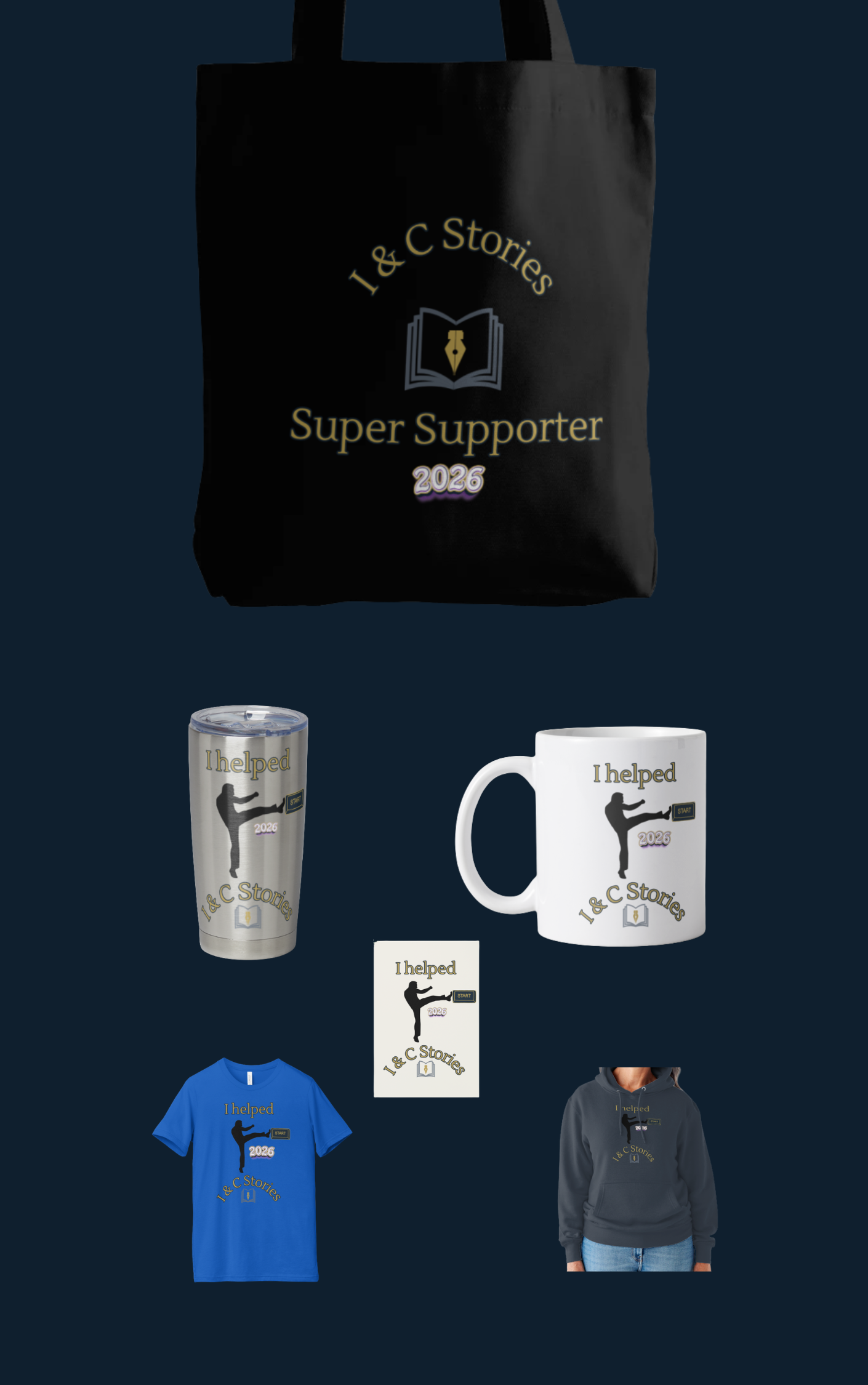
Each year, a new special “I helped” product line will be introduced on January 1. The net proceeds from each product line will be allocated to the following publication year’s operations. For example, funds raised through 2026 sales will be allocated to the 2027 issues, including establishing a contributor fund that will allow us to pay not only new contributors but also the writers and artists who have so generously agreed to forego upfront payments.
The Goal
Given how late in the year it already is, I wanted to set an attainable goal. So, our goal for 2026 is to reach $30,000 in gross sales between the product line and subscriptions. In the event we do not reach our goal, net proceeds will still go toward the contributor payment fund for next year. Net proceeds beyond what is needed for contributor funding will help support daily operations, and excess funding will be reserved for the following year’s contributor fund.
2026 Products
The inaugural “I helped” product line includes a coffee mug, an insulated tumbler, a refrigerator magnet, a T-shirt, and a hoodie. Each item can be purchased individually, or if you’re feeling extra supportive this year, you can purchase the Super Supporter Pack that includes one of everything plus a canvas tote you can use to haul your books and swag around in. You can view and order this year’s products here.
Additionally, while the magazine will remain free to all on the 8th of each month on our website, we’re offering a subscription option that will give subscribers access to the same stories a week early via a downloadable PDF delivered straight to their email. Subscribe here.
We appreciate your support!

Behind the Themes: What’s Changing and Why
Where'd the themes go? Find out here.
Read more →
When I founded I & C Stories, I built our first publication year around twelve predetermined themes. I loved the idea of creating an issue around a concept and finding stories that explored it in different ways.
Then I started reading.
Over the past several months, I've had to turn away stories I genuinely loved—not because they weren't strong enough for I & C Stories, but because I couldn't find a place for them within the themes I'd chosen.
That didn't sit right with me
I & C Stories was created to lower barriers to publication and give exceptional stories a home. A theme should help us curate great fiction for our readers. It shouldn't become another barrier preventing us from publishing it.
So we're changing the order.
Going forward, we'll acquire the stories first and build our themes around them.
Our standards aren't changing. Our commitment to themed monthly issues isn't changing. What is changing is when those themes are determined. Rather than asking writers to fit their work into a theme we've chosen in advance, we'll select the strongest stories we can find, look at what connects them, and allow each issue's identity to emerge from the work itself.
Our 2027 Founder's Edition will retain the themes that started I & C Stories. They're part of our history, and I want them to remain part of it. But as we continue acquiring work for 2027, we're giving ourselves more freedom to say yes to exceptional stories—even when they don't fit neatly into one of the boxes we created before we'd read them.
Sometimes building something means discovering that the best version of an idea isn't quite the version you started with.
And sometimes the stories tell you what they want to become.
What if my submission was previously rejected for theme alignment?
If we previously declined your story specifically because we could not find a strong enough connection to one of our planned themes, you are welcome to submit it again under our new approach. Our decision to move away from predetermined themes means theme alignment is no longer a requirement for publication consideration. The story will be considered on its merits under our current editorial standards. As always, resubmission does not guarantee acceptance, but a previous theme-fit decision will not count against the work.
We do appreciate your patience as we find our footing and refine our policies and processes.
Behind the Blank First Page: Why It Existed & Why It’s Changing
A look at one of our outdated submission guidelines.
Read more →
I’d like to take a moment to thank everyone for accepting our Blank First Page policy. Allow me to pull the curtain back and expose the policy. One of our goals here at Ink & Consequences, and thus I & C Stories, is to remove some of the mystique shrouding publishing. So for our inaugural Behind the ____ blog post, we’ve decided to address the Blank First Page.
What were we trying to accomplish with the Blank First Page?
When we first started accepting submissions back in July, I’d had limited exposure to the Duosuma platform. I had no idea how many of the functions worked because during my tenure as an intern we didn’t use most of them. Knowing that we may occasionally request specific revisions for some pieces, we needed a way to identify these “new” submissions when they came back to us while preserving blind review.
In my infinite wisdom, I concocted what I felt was the perfect solution. We would generate and attach a special code to the request that the writer would be asked to place on this blank page. That would allow us to know at a glance if a submission was new or a requested revision and where to route it when it arrived.
What changed?
As submissions started coming in and we actually sent out a revision request, I spotted a feature I’d overlooked—or perhaps it was added in the time between my internship and the launch. Duosuma allows us to “Request New File(s),” which lets writers submit the requested revised work and keep it linked to the original submission.
Why not update the policy before now?
As with any change, I needed time to look at the policy from every angle. In order to prevent prematurely removing it only to add it back later, I had to consider whether it continued to serve the process before retiring it. I also felt it would be unfair to those who got rejected for not having one to change the guidelines mid-season.
Why change it now instead of leaving it?
As I close out our second month of this inaugural submission season, I felt it would be a good time to take a look at our numbers. I determined that the requirement was causing more work for all of us for no clear reason other than that’s the way we started. With it having no clear editorial purpose, and no foreseeable reason to become necessary in the future, I decided to retire it.
What if my submission was previously rejected for this policy?
While many of you have graciously accepted this policy and resubmitted to meet the guidelines—something we appreciate more than you know—we understand why some haven’t. As I previously mentioned, it was one of the reasons I was hesitant to change mid-season. Fortunately, because non-compliant submissions are not read, the blind still remains intact and you can resubmit should you choose to do so.
We do appreciate your patience as we find our footing and refine our policies and processes.

Why Ink & Consequences Exists
A look at the philosophy behind I & C and why stewardship matters more than scale.
Read more →
Ink & Consequences was not created to chase trends, inflate slush piles, or replicate legacy publishing systems without question.
It exists because stories matter — and the way they are stewarded matters just as much.
Traditional publishing can produce extraordinary work. It can also be opaque, impersonal, and structurally misaligned with the people creating the stories. Response times stretch indefinitely. Rejections arrive without context. Editorial labor is compressed into unsustainable cycles. Writers are expected to feel fortunate simply to be considered.
Ink & Consequences was built to do things differently.
1. To Champion Editorial Transparency
Editing is not gatekeeping.
It is stewardship.
Every submission is read intentionally. Decisions are documented. When a piece is declined, the reason is clear. When revision is invited, it is specific. When a story is accepted, it meets the standard — not a passing trend.
Writers may not always agree with a decision. But they will understand it.
Transparency is not optional here. It is operational.
2. To Build Sustainable Creative Systems
Creative work should not require burnout.
Ink & Consequences operates with structured editorial stages, defined roles, and monitored response windows. Themes close when filled. Workloads are distributed deliberately. Timelines are adjusted transparently if volume shifts.
A publication cannot advocate for humane treatment of writers while exhausting the editors behind the curtain.
Sustainability is not branding. It is infrastructure.
3. To Publish Stories Where Choices Matter
The name is intentional.
Ink & Consequences seeks fiction that lingers. Stories where emotions resonate, relationships evolve, and experiences leave their mark. Sometimes that impact comes from a single choice. Sometimes it comes from love, loss, hope, or simply a moment that changes everything.
We are less interested in spectacle for spectacle’s sake. We are interested in meaning.
4. To Create a Publishing Model Built to Endure
Ink & Consequences is an independent publisher commited to long-term standards, clear stewardship, and intentional growth.
Our goal is not volume. Our goal is quality, clarity, and consequence.
What You Can Expect
- Blind submissions
- Clear, accessible guidelines
- Defined response timelines
- Transparent editorial standards
- Respect for your work
No writer is entitled to publication. But every writer is entitled to respect.